
Academic
Curriculum
PDIE UNDIP’s Scientific Vision:
To become a leading doctoral program that provides freedom of thought in exploring and developing creative and innovative ideas to maintain the continuity of knowledge and solve problems in the fields of economics, management, and accounting, while gaining national and/or international recognition.
Graduate Profile:
Scientists: Creative, innovative, and transformative graduates capable of developing and disseminating knowledge and solving problems in the fields of economics, management, and accounting through interdisciplinary, multidisciplinary, or transdisciplinary approaches; proven nationally and internationally.
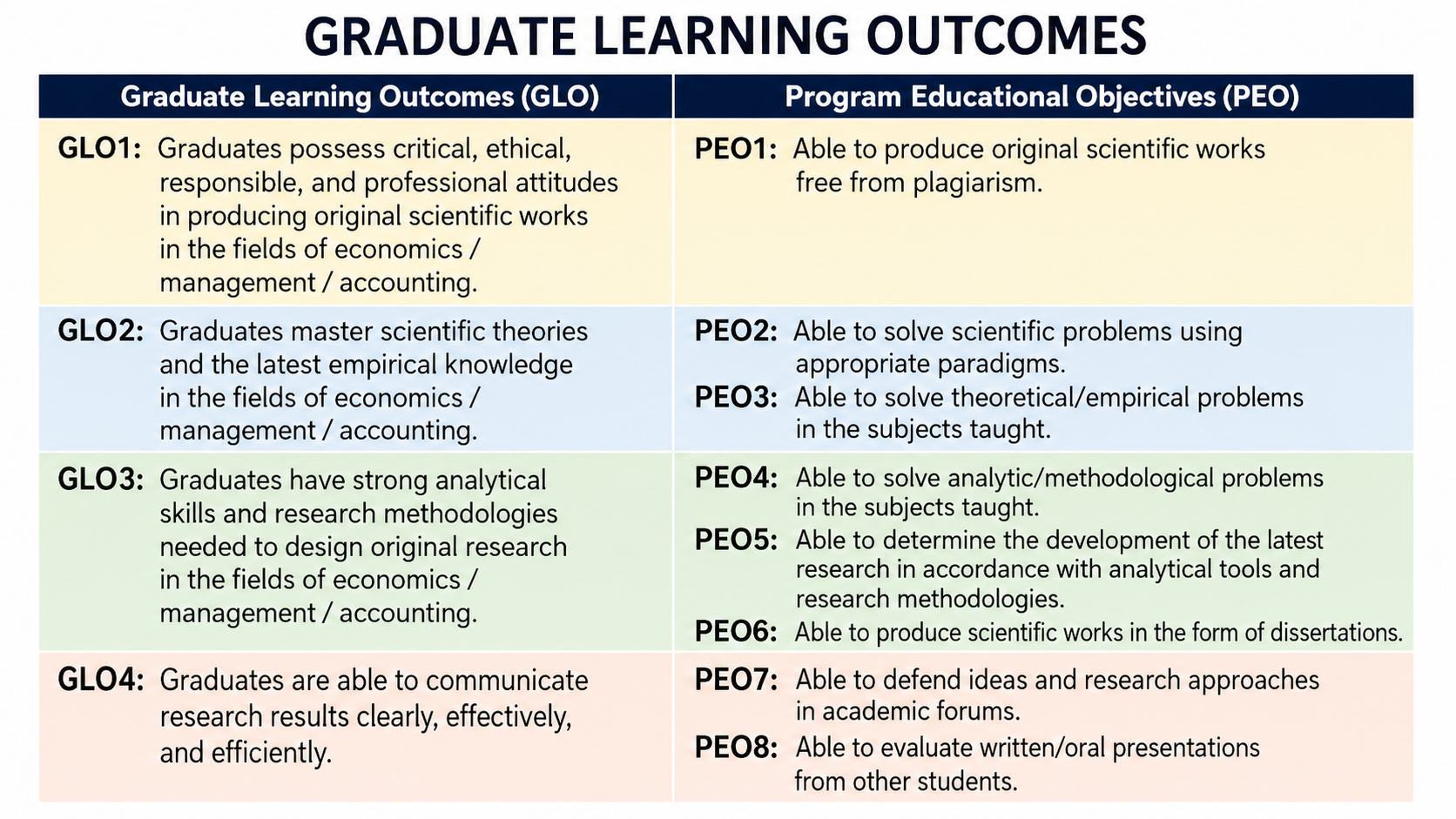
Course Map
Doctor By Course
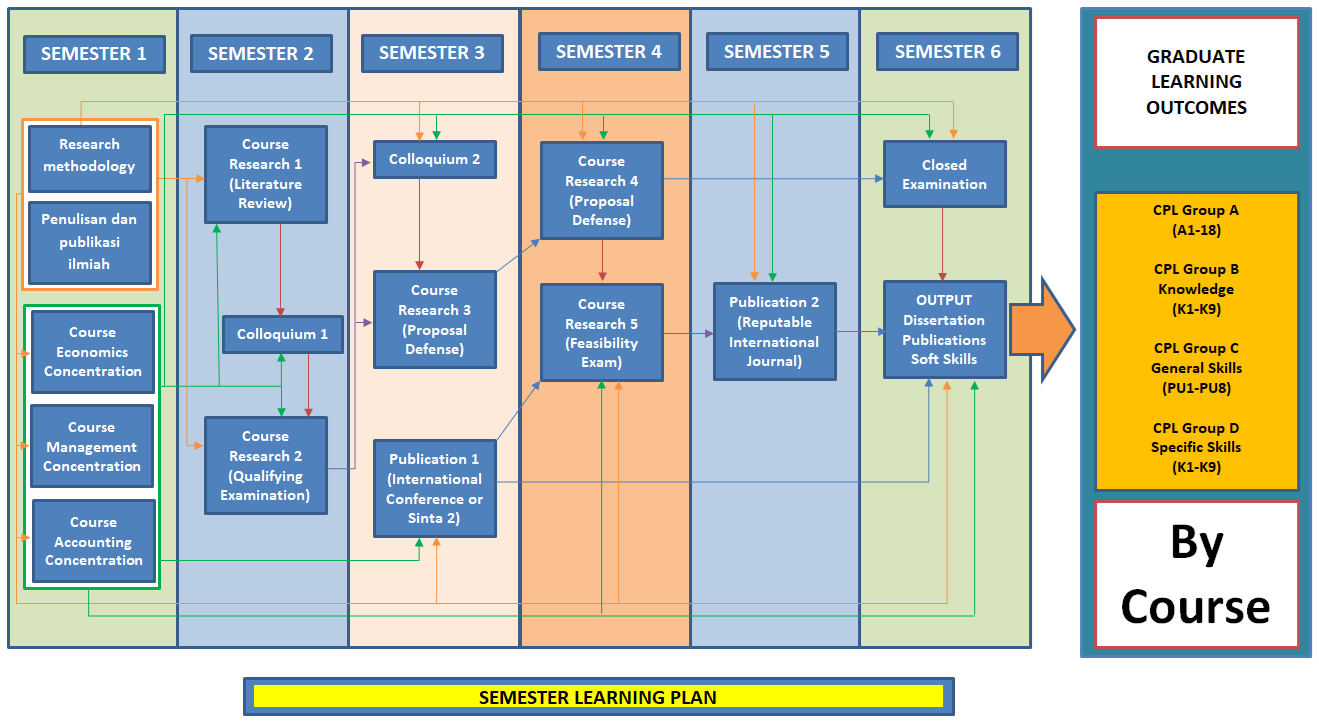
Doctor By Research
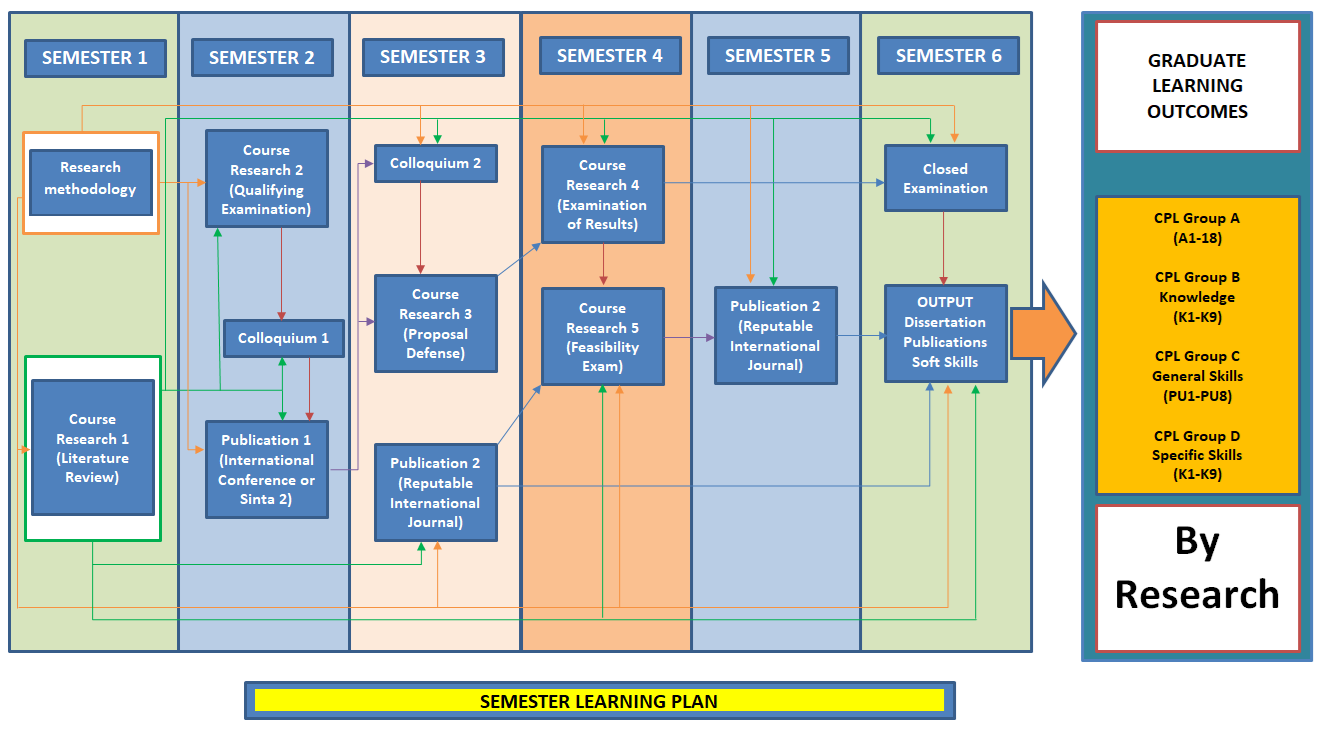
Course List
The Doctoral Program in Economics can be completed in 3 years and 6 semesters, with a maximum study period of 6 years (12 semesters). For students with above-average abilities, the study period can be completed in 2.5 years (5 semesters). To complete the Doctoral Program in Economics, students must complete a total of 90 credits, consisting of the following courses:
Doctoral By Course
1. Compulsory Courses (12 credits):
- Philosophy of Science in Management-Economics-Accounting: 3 credits
- Advanced Research Methodology in Economics-Management-Accounting: 3 credits
- Academic Writing and Publication: 3 credits
- Econometrics and Multivariate Analysis: 3 credits
2. Concentration Courses (12 credits):
A. Economics Concentration
- Advanced Microeconomics: 3 credits
- Advanced Macroeconomics: 3 credits
- Advanced Development Economics (Advanced Development Economics): 3 credits Current Issues in Economics Research: 3 credits
B. Management Concentration
1. Marketing Management
- Empirical Models in Marketing: 3 credits
- Current Issues in Marketing Theory: 3 credits
- Marketing Theory: 3 credits
- Seminar in Consumer Behavior: 3 credits
2. Financial Management
- Empirical Models in Finance: 3 credits
- Current Issues in Finance Theory: 3 credits
- Financial Management Theory: 3 credits
- Seminar in Finance Research: 3 credits
3. Human Resource Management
- Empirical Models in Human Resource Management: 3 credits
- Current Issues in Human Resource Management Theory: 3 credits
- Human Resource Theory: 3 credits
- Human Resource Management: Strategy, Laws, and Ethics: 3 credits
C. Accounting Concentration
- Qualitative Accounting Research: 3 credits
- Market-Based Accounting Research: 3 credits
- Behavioral Accounting Research: 3 credits
- Current Issues in Accounting: 3 credits
3. Research Courses (18 Credits)
- Research Project 1: 4 credits
- Colloquium 1: 4 credits
- Research Project 2: 6 credits
- Colloquium 2: 4 credits
4. Publication Course (18 credits)
- Publication 1: 6 credits
- Publication 2: 12 credits
5. Dissertation Course (30 credits)
- Research Proposal: 6 credits
- Research Findings Seminar: 6 credits
- Doctoral Thesis Defense: 6 credits
- Dissertation: 12 credits
Doctoral By Research
1. Research Course (30 credits):
- Advanced Research Methodology (4 credits)
- Academic Writing and Publication (4 credits)
- Research Project 1 (4 credits)
- Research Colloquium 1 (6 credits)
- Research Project 2 (6 credits)
- Research Colloquium 2 (6 credits)
2. Publication Course (30 credits):
- Publication 1 (6 credits)
- Publication 2 (12 credits)
- Publication 3 (12 credits)
3. Dissertation Course (30 credits):
- Research Proposal (6 credits)
- Research Findings Seminar (6 credits)
- Doctoral Thesis Defense (6 credits)
- Dissertation (12 credits)
Note:
1) Compulsory courses and concentrations are taught through structured lectures in accordance with the academic regulations at Diponegoro University.
2) Concentration Courses are elective courses that students can choose based on their desired field of study.
3) Research Courses are courses taken through research stages, resulting in the primary outputs, namely a dissertation and publication.
- Colloquium 1 is a lecture activity conducted to produce a draft proposal with a focus on finding novelty (Chapter 1).
- Colloquium 2 is a lecture activity conducted to produce a draft complete research proposal (Chapters 1-3).
- Research 1 is a lecture activity conducted to produce a literature review report.
- Research 2 is a lecture activity conducted to produce a draft proposal that passes the qualifying (prelim) exam.
- Research 3 is a lecture activity conducted to produce a research proposal that is suitable for acceptance for a dissertation.
- Research 4 is a lecture activity conducted to produce a dissertation research report that is approved in a research results seminar.
- Research 5 is a lecture activity conducted to produce a dissertation research report that is deemed suitable for the examination stage Closed.
- Publication 1 is a single article published in an accredited national journal (min. Sinta 3) or reputable international proceedings.
- Publication 2 and Publication 3 are single articles published in a reputable international journal. Publication 3 is only required for doctoral students by research.
4) The Colloquium course can be taken in other study programs at Diponegoro University (maximum 4 credits) or in other study programs accredited A or Superior at other universities (maximum 6 credits).
5) Students by Research are required to take a structured course of 3 credits, namely Research Methodology, and Publication 3 (7 credits).
6) Evaluation of Learning Outcomes:
- Structured Courses: Course learning outcomes are evaluated using four assessment components: Assignment 1, Assignment 2, Midterm Exam, and Final Exam. The format and content of assignments and exams are entirely up to the instructor (through the course coordinator) according to the characteristics of each course.
- Research and Publication Courses: Course learning outcomes are evaluated using specific indicators established in the study program’s specific regulations.
- Publication Requirements: Articles must include the student’s name as the first author, and the academic supervisor/Promoter/Co-Promoter as subsequent authors, using Diponegoro University as the primary affiliation. If the journal provides more than one affiliation, the student may use their institution’s name as the secondary affiliation. Articles are not permitted to include the names of other students from Diponegoro University or authors outside of Diponegoro University.
Concentration in Economics (Total 90 credits)

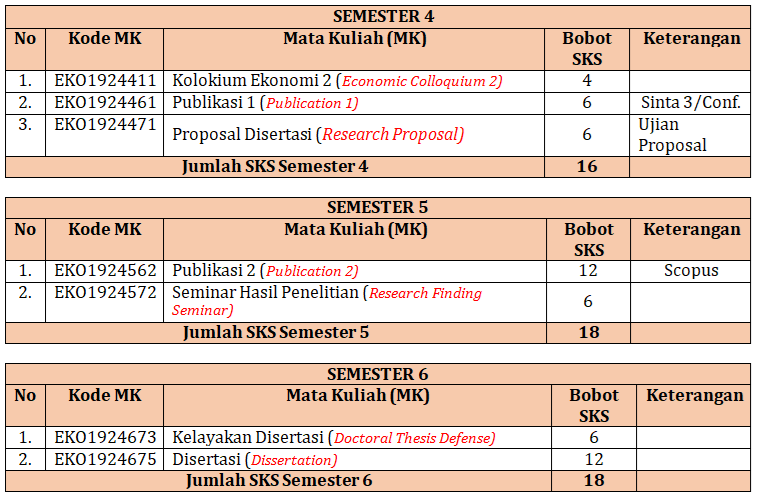
Management Concentration (Total 90 credits)


Accounting Concentration (Total 90 credits)


Doctor By Research

